
 |
|
 |
|
 |
|
 |
|
 |
|
 |
|
 |
|
 |
|
 |
|
 |
|
 |
|
 |
|
 |
|
 |
|
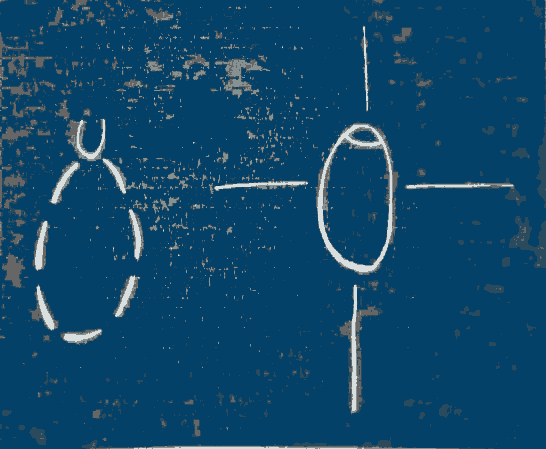
This capacity.
In turbulence, form is precarious, an arbitrary limit.
Lose yourself.
As if there were an opening onto distant figures of nothingness.
Repose in the phosphorescence, being authentic gets you nowhere!
Imperium, I do whatever I please.
I call it a body without morals.
Text
from :
"Telematic Beings (and I) . . . "
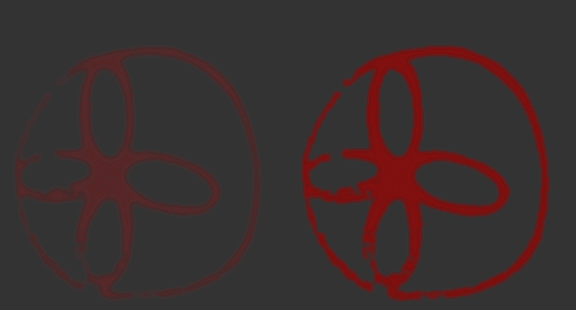
|
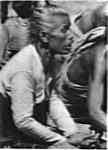
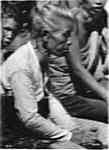
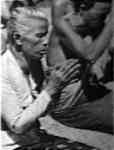
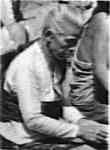
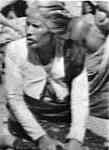
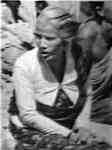
"Djero Balian rubs her hands together. She habitually marks the moment of going into trance by suddenly plunging her hands into the embers of the incense brazier (not shown in the sequence of photographs). Immediately after this she rubs her hands together as shown. she has already taken on the facial expression usual in her trances, an expression of mixed agony and ecstasy with the eyebrows drawn together, forehead wrinkled, and the corners of her mouth drawn down." From Balinese Character (A Photographic Analysis), pp70-71, Gregory Bateson and Margaret Mead 1942. New York Academy of Sciences |

Lines of thought _____ Albert Vidal In Sol Interior : SEER OF THE TELLURIC ART Performances and actions have proved to me that the tragic sense of life, that one which is not dramatic, manifests itself with naturalness. Nature does not dramatize, nature acts through an unrestrainable impulse of existence. Albert Vidal Rehearsal -IV- Diary of the Working Process of Soul of Snake, 1987 The weight of the earth, the density of the earth, the mythic gravity of the earth, initiate Albert Vidal into his telluric vision of art, embodying and being embodied by the metamorphic gaze of Soul of Snake. His body surrounded by earth, a tube connects his lungs to the air and to the light. This is his studio, his hermitage. There, the Masia La Plana, a farm house inscribed in the archives of the town Vidrà from the XII century, and before, an ancient Iberic emplacement in the Catalan Pyrenees. There, I saw, for the first time in synchronic perception, a Tibetan temple. Sol interior- a metamorphic motion in sonic vibration. ONE TRAVELS BY INTENSITY ONE TRAVELS ALONG INTENSITIES TO TRACE A PATH BETWEEN IMPOSSIBILITIES, WHEN FORM IS FORCE, WHEN SOUND IS AN EXISTING WAVE. AND HOW DOES ALBERT VIDAL NAME IT? LOOK CLOSELY AT THE ANCESTORS AND NOT A FIGURE OF THE PAST, A COEXISTENCE OF PASTS IN A PRESENT DURATION. LOOK CLOSELY AT THE CULTURES. THERE HE RECOGNIZES PRESENCES, SOUNDS AND IMAGES, RESONANT WITH HIS TENDENCY. IT IS AN ADVENTURE INTO CHAOS TO BE A LINE OF ABSOLUTE PRECISION. IT IS AN ADVENTURE INTO A CONFRONTATION WHERE RESONANCE IS AN EQUALITY: WHERE RESONANCE IS A MEDIATION, AN ENTRY INTO A VIBRANT INTERVAL, SOUND BECOMES BOTH IMAGE AND MOVEMENT. YOU MAY SAY THE TELLURIC SOUND IS MATTER YOU MAY SAY THE TELLURIC SOUND IS DURATION. EACH SOUND IS A GESTURE EACH GESTURE AN ACTUALIZATION EACH ACTUALIZATION AN INTUITIVE WHOLE. SOUND ACTS ON ALBERT VIDAL BREATHING MOVEMENT INTO HIM, SOUND BECOMES HIS BODILY EXPERIENCE. HE SURFS THE SOUND AND REVEALS A METAMORPHIC FLUX: GAZE UPON THE SOUND. IMAGINE THE POTENTIAL OF PERCEPTION. GAZE UPON A CONTINUOUS FLUCTUATION. The body, the unfathomable and comprehensive corpus, ...emanations, silences, inhabited expectations of an interiority... THERE IS PRECISION THERE IS COMPASSION THERE IS EMOTION THERE IS INTUITION THERE IS ANGEL THERE IS DREAM THERE IS COLOUR THERE IS DENSITY THAT OPENS YOU THE HEART THERE IS A TENDENCY A SYNESTHETIC NUMINOUS TOUCH a Telluric mode of thought envisioned by the Telluric Singer Albert Vidal IN POLYVOCALITY IN RESONANCE IN DEVOTIO SYMPATHETICA with the Tibetan Master of the Piwang Jamiang Dorje OF A HIGH SPIRITUAL AND COMPASSIONATE CULTURE THE TIBETAN BUDDHISTS OF THE HIMALAYAS DISTINGUISHED BY THEIR SACRED AND IMAGINAL SENSE OF EXISTENCE ...it is an unrestrainable impulse Andrew Colquhoun & Maria De Marias, London, February 1999. References: Henri Bergson; Gilles Deleuze: Henri Corbin; James Hillman; Marshall & Eric McLuhan |
Lines of thought _____ on the Telluric Body If video performance from its very inception committed itself to a strict sense of what is real, the telluric mode works out this sense of reality, nonetheless, after a first leap: what is addressed as real is Fiction. What the Spanish artist Albert Vidal (Barcelona 1946) proposes at the outset of his telluric search is a serious play: the enactment of what in animist societies is called possession or in a more objective language the phenomena of morphologic transformation. Telluric is from the Latin tellus the earth, and denotes anything relating or originating in the earth or soil. Vidal introduces the term bearing in mind a kind of anthropomorphic imagery that is found mainly in sacred art and ancient art until the Gothic western period. A few traditional ceremonial practices survived in isolated tribal cultures. These practices and traces (traces of memories recorded in the artefact), relate directly with the experience of trance or ecstasy. This singular phase of Vidal's itinerary inchoates since the moment he approaches the performer's body of fiction in terms of energy matter, and motion, in terms of energy processes. The etymologies of trance and ecstasy evoke a kind of displacement, except that this change of place or position - motion - is located primarily in the consciousness of the subject. Thus, video, in the context of the Telluric Body screened records motions but fundamentally the ones that take place in the performer's consciousness. In a sense the movement of consciousness is a non spatial motion. And consciousness for the telluric performer (and for the actor ab-origine: the sorcerer, the medium) is always a corporeal thought that we shall see, inscribes duration with becoming. Therefore transformation of consciousness goes along with the state of morphological transformation that defines possession. Video becomes the mediator of the metamorphic process. The way the telluric possessions were enacted, video documented and reviewed when I started working with Albert Vidal in 1990, proved to be the main creative source. Time Based Media entered the arena of performance in a time when a new complexity was struggling to emerge from between the scenic parameters: this is the construction of a flow based on non linear, non discursive and non linguistic states. Maria De Marias From : Albert Vidal: The Telluric Body Screened, Maria Escobedo. Thèse de Master in Arts-Independent Film and Video, The London Institute, Londres, 1998. |
Lines of thought _____ Manuel De Landa "We live in a world populated by structures - a complex mixture of geological, biological, social and linguistic constructions that are nothing but accumulations of materials shaped and hardened by history. Immersed as we are in this mixture, we cannot help but interact in a variety of ways with the other historical constructions that surround us, and in these interactions we generate novel combinations, some of which possess emergent properties. In turn, these synergistic combinations, whether of human origin or not, become the raw material for further mixtures. This is how the population of structures inhabiting our planet has acquired its rich variety, as the entry of novel materials into the mix triggers wild proliferations of the new forms. In the organic world, for instance, soft tissue (gels and aerosols, muscle and nerve) reigned supreme until 500 million years ago. At that point, some of the conglomerations of fleshy matter-energy that made up life underwent a sudden mineralization, and a new material for constructing living creatures emerged: bone. It is almost as if the mineral world that had served as a substratum for the emergence of biological creatures was reasserting itself, confirming that geology, far from having been left behind as a primitive stage of the earth's evolution, fully coexisted with the soft, gelatinous newcomers. Primitive bone, a stiff, calcified central rod that would later become the vertebral column, made new forms of movement control possible among animals, freeing them from many constraints and literally setting them into motion to conquer every available niche in the air, in water, and on land. And yet, while bone allowed the complexification of the animal phylum to which we, as vertebrates, belong, it never forgot its mineral origins: it is the living material that most easily petrifies, that most readily crosses the threshold back into the world of rocks. For that reason, much of the geological record is written with fossil bone. The human endoskeleton was one of the many products of that ancient mineralization. Yet that is not the only geological infiltration that the human species has undergone. About eight thousand years ago, human populations began mineralizing again when they developed an urban exoskeleton: bricks of sun-dried clay became the building materials for here homes, which in turn surrounded and were surrounded by stone monuments and defensive walls. This exoskeleton served a purpose similar to its internal counterpart: to control the movement of human flesh in and out of a town's walls." From A Thousand Years of Non-Linear History, pp.25-27. Manuel De Landa, Swerve, 1998. |
Lines of thought _____ Henri Michaux ". . . . . . . . . . . . . . . . . . . . . Something incredible, something desperately desired from childhood on, apparently denied me, something I certainly would never see, unheard of, inaccessible, too beautiful, sublime, forbidden to me—it happened. I SAW THE THOUSANDS OF GODS. I was given that marvellous gift. Faithless as I am (without realizing the faith I might have had), they appeared for me. They were there, present, more present than anything I've ever looked at in my life. And it was impossible and I knew it, and still. Still, they were there, arrayed in their hundreds one beside the other (but thousands followed, hardly perceptible—even more than thousands, an infinity). They were there, those calm beings, noble, suspended in the air by seemingly natural levitation, moving very slightly or rather animated in place. They—those divine beings—and I: alone facing each other. Out of something like gratitude, I was theirs. But really, one might say, what did you believe? I reply: Believing simply doesn't matter, SINCE THEY WERE THERE! Why should I argue about it, since I was completely happy? They were not at a great height, but at all the height needed to keep their distance while revealing themselves, to be revered by the man who witnesses their glory and recognizes their incomparable superiority. They were natural, as the sun in the sky is natural. I didn't move. I didn't have to bow. They towered over me quite enough. It was real, like an understanding between us from a previously arranged agreement. I was full of them. I had stopped being unfilled. Everything was perfection. I had no need to think, or weigh, or criticize, anymore. No need to compare anymore. My horizontal was now vertical. I existed at a height. I had not lived in vain. ( . . . )" From Turbulent Infinity (L'Infini turbulent), passage selected by Henri Michaux for inclusion in his anthology, Choix de poemes, Gallimard. Translation, David Ball 1997. |
Lines of thought _____ Ogotemmêli "'When a Hogon dies, a copper ring is put round each of his ankles and arms. These rings come from the original primal field, the grave of Lebe. They were made of metal excreted by the seventh Nummo after the swallowing. Once again Ogotemmeli explained the nature of copper. The rays falling from the clouds are changed into copper on touching the ground. Not on the surface of the ground, however, but deep in the earth, too deep for men to be able to lay hold of it, the transformation takes place. Lebe's copper was found, because it was in the grave they had dug for him. [. . .] 'Copper,' he said, belongs to the Nummo: he is copper: he excretes copper. Very good! But then he could take back the metal at anytime and in any place, and not merely when anyone carrying it passes by water.' 'Did I not tell you,' was the answer, that copper is also water? To pass with the metal near certain waters is to risk seeing it return to the water, and to be carried away with it oneself.' In fact, if copper is closely connected with the Nummo and he is water, the liquid and the metal are of the same essence. Ogotemmeli then resumed his concrete explanations of the foundation of Dogon thought. 'The sun,' said he, 'is a burnt-up land surrounded by a spiral of copper raised to a state of incandescence which gives it its diurnal motion, which in turn gives light and life to the universe. The sun is, so to say, molten copper, in proof of which the metal in the fire throws off rays like those of the sun. But these rays, as I have told you, draw up moisture and make clouds. They are the channels by which the water passes: they are water. Proof of this is the fact that they are visible only in times of warm mists and storms. That is why solar rays are called menn di (copper water)." From. Conversations with Ogotemmêli, Marcel Griaule 1965. pp.119-121 |
|
Lines of thought _____ Bill Viola " —Note, December 12, 1986 Death by beauty. Death by sensitivity. Death by awareness. Death by experience. Death by landscape. The dark side of vision. Images of such striking beauty and clarity that they pierce the heart and inflict pain. Like heroin, the flirtation with mortality can be addictive. The drug of sense. The trip to the desert is one of discovering the deep common roots of beauty and pain, of sensitivity and death. To be sensitive to all frequencies at once, to be overwhelmed and delirious with sensory experience. (Use of camera tubes sensitive to all frequencies—lenses sensitive to all distances.) The articulation of the self through the extreme sensitivity and heightened awareness (right mind) is the great work—the true medium. There is no other. It is the source of video. Where to put the mind is the primary question of composition, and of the creative act." From, Reasons for Knocking at an Empty House, 1995, p.183. Thames and Hudson. |
Lines of thought _____ Henri Bergson "There are then, succeeding one another, billions of vibrations, that is a series of events which, even with the greatest possible economy of time, would take me thousands of years to count. Yet these dull and monotonous events, which would fill thirty centuries of a matter become self-conscious, occupy only a second of my own consciousness, able to contract them into one picturesque sensation of light. Moreover, just the same could be said of all the other sensations. Placed at the confluence of consciousness and matter, sensation condenses, into the duration which belongs to us and characterizes our consciousness, immense periods of what we can call by analogy the duration of things. Must we not think, then, that if our perception contracts material events in this way it is in order that our action may dominate them? Supposing the necessity inherent in matter be such that at each of its moments it can be forced, but only within extremely restricted limits, how in such case must a consciousness proceed if it would insert a free action into this material world, let that action be no more than releasing a spring or directing a movement? Would it not have to adopt precisely this method? Should we not expect to find between its duration and the duration of things a difference of tension such that innumerable instants of the material world could be held within one single instant of the conscious life, so that the desired action, accomplished by consciousness in one of its moments, could be distributed over an enormous number of the moments of matter and so sum up within it the indeterminations almost infinitesimal which each of them admits? In other words, is not the tension of the duration of a conscious being the measure of its power of acting, of the quantity of free creative activity it can introduce into the world? I hold that it is, but for the moment I will not press this. All I wish to say is that this new line of facts leads us to the same conclusion as the former line. Whether we consider the act which consciousness decrees or the perception which prepares that act, in either case consciousness appears as a force seeking to insert itself in matter in order to get possession of it and turn it to its profit. It works in two complementary ways:— in one, by an explosive action, it liberates instantly, in the chosen direction, energy which matter has been accumulating during a long time; in the other, by a work of contraction, it gathers into a single instant the incalculable number of small events which matter holds distinct, as when we sum up in a word the immensity of a history." From Life and Consciousness. The Huxley Lecture delivered in the University of Birmingham, May 24, 1911. First published in Mind-Energy. Lectures and Essays, 1920. pp21-22. Translated by H. Wildon Carr |